Reusable Transport Packaging:
A strategic pillar for less waste, supply chain disruption, and cost
The Circular Economy Act (CEA) represents a significant evolution in European circular economy policy. At a time of growing geopolitical uncertainty, increasing dependence on third countries for critical raw materials, and intensifying global competition, circularity has become a strategic economic imperative as much as an environmental objective.
Building on the priorities identified in the Draghi and Letta reports, the Clean Industrial Deal and the Competitiveness Compass, the Circular Economy Act is expected to strengthen the resilience of European industries and supply chains, improve resource efficiency, reduce external dependencies and support long-term competitiveness.
To achieve these objectives, the Act should recognise that circularity begins not with waste management, but with waste prevention. A more competitive and resilient Europe requires solutions that reduce waste, minimise supply chain disruptions and lower costs for businesses. Reuse systems, and reusable transport packaging (RTP) in particular, already help deliver these outcomes. By extending product lifetimes, reducing demand for virgin materials, and maintaining valuable resources within the European economy, RTP contributes directly to industrial resilience, strategic autonomy, and economic performance and employment.
However, the current policy debate surrounding the CEA remains largely focused on recycling, secondary raw materials, and waste management. While these elements are essential to reducing external dependencies and strengthening Europe’s circular economy, such a narrow focus risks overlooking solutions that prevent waste from being generated in the first place.
This is not solely an environmental consideration. It is a competitiveness issue. The CEA should therefore explicitly recognise and support reuse as a strategic pillar of Europe’s circular economy framework.
The critical and proven backbone of European supply chains
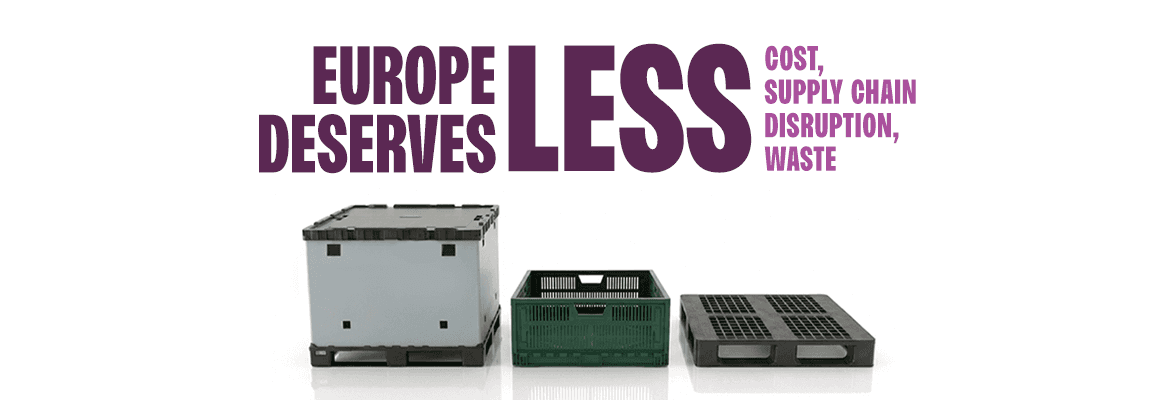
Reusable transport packaging forms an essential part of Europe’s industrial infrastructure and supply chains. For decades, RTP has been delivering resilient, cost-effective, and efficient solutions, forming the invisible backbone of industries from automotive and agriculture to retail, manufacturing, and pharma. Its durability ensures the protection of goods throughout transport and storage, while established reverse logistics systems enable long service lives, operational efficiency, and lower lifecycle costs. As a result, RTP has become a trusted and scalable solution across a wide range of industries.
A future-proof solution for a more autonomous and sustainable Europe
Europe’s resilience and competitiveness increasingly depend on reducing external resource dependencies. By remaining in circulation for up to 15 years, reusable transport packaging reduces demand for virgin raw materials and contributes to more efficient resource use. This helps become less dependent on raw material availability, supporting the strategic autonomy and resilience of European supply chains.
Furthermore, RTP significantly contributes to Europe’s decarbonisation by reducing environmental impacts across its lifecycle, including manufacturing, use, reconditioning, and end-of-life recycling. The recycling of high-quality plastics used for manufacturing RTP also helps retain valuable secondary raw materials within the European economy.
The blueprint for a circular and waste-free economy
Reusable transport packaging embodies the core principle of the circular economy. Designed for repeated use, reconditioning and repair, and eventual recycling at the end of life, RTP prevent waste generation by default. This approach aligns directly with the waste hierarchy established under the Waste Framework Directive, which identifies reuse as the most efficient way to prevent waste. While recycling remains an essential component of a circular economy, reuse offers an upstream solution that avoids waste generation altogether.
Policy recommendations
To fully harness the contribution of reusable transport packaging to Europe’s competitiveness, resilience, and circularity objectives, the RCTP calls on policymakers to include the following measures in the Circular Economy Act.
Explicitly anchor reuse within the Circular Economy Act
The Circular Economy Act should clearly recognise reuse as a strategic instrument and ensure that future policy measures remain aligned with the waste hierarchy. Recycling will remain essential. However, policy frameworks should primarily support solutions that prevent waste generation and extend the life of products. This requires incentivising reuse over recycling while avoiding measures that could unintentionally disadvantage reuse systems.
Reform EPR schemes to create a single circular market promoting reuse
Manufacturers placing products on the EU market currently face a fragmented landscape of Extended Producer Responsibility (EPR) schemes. This patchwork of national requirements creates administrative burdens and undermines the functioning of the Single Market.
The CEA should support greater harmonisation through a centralised EPR register and more consistent EPR requirements across the EU. Such measures would reduce administrative complexity, simplify reporting obligations, and contribute to the creation of a genuine circular Single Market.
Further, reusable products should be exempt from EPR fees in all EU Member States, reflecting the EU waste hierarchy’s prioritisation of waste prevention and reuse. Reusable products remain in circulation for many years and directly contribute to preventing waste generation. Applying EPR fees to products that already deliver this objective risks undermining their environmental and economic benefits and discouraging investment in reuse infrastructure.
Where reusable products remain within the scope of EPR schemes, eco-modulation should be based on waste prevention performance and recyclability rather than solely on recycled content. Current approaches often overlook the fact that reuse prevents waste generation altogether and can achieve significantly higher levels of material retention over time. A prevention-based eco-modulation framework would also align financial incentives with the EU’s circular economy objectives by encouraging product design, logistics, and business models that maximise lifespan and reuse cycles.
Use public procurement to scale circular solutions
With a budget of approximately €2 trillion, public procurement represents a major opportunity to accelerate the uptake of circular solutions across Europe. Public procurement frameworks should require authorities to consider reusable solutions wherever appropriate. Circularity criteria should become a standard consideration in procurement decisions, recognising that reusable systems are already proven, operational, and ready to scale also in the public sector.
Public institutions such as schools, prisons, and hospitals can use RTPs for food and materials deliveries, and hospitals can procure sterile RTPs for pharmaceuticals, medical devices, and bed linens. Even the canteen in the European Parliament in Strasbourg uses RTPs. Similarly, cities hosting large events increasingly incorporate sustainability criteria into procurement processes for consumer-facing products such as reusable cups. However, reusable transport packaging often remains overlooked despite its proven role in supporting collection, return, and logistics behind the scenes.
Ensure fair competition through certification of imports
Low-quality imported products can undermine the development of a competitive and sustainable circular economy for reusable transport packaging.
To maintain a level playing field and safeguard the integrity of Europe’s circular economy, RTP products imported from non-EFTA countries should be subject to robust certification and verification mechanisms. Similar processes are already in place under the EU Carbon Border Adjustment Mechanism Regulation. This measure is necessary to ensure compliance with EU environmental standards and recycled content requirements, help preserve the quality of secondary materials circulating within the European market and support fair competition for companies investing in high-quality circular products.
Summary: Our vision for the Circular Economy Act
- Place reuse at the heart of the Circular Economy Act, in line with the EU waste hierarchy.
- Harmonise EPR schemes across the EU and reward waste prevention through appropriate eco-modulation and by exempting reusable products from EPR fees.
- Use public procurement rules to favour circular solutions based on reuse and help scale up these business models in cases where the reusable option is also available.
- Introduce robust certification requirements for RTP products imported from non-EFTA countries to ensure fair competition and maintain the integrity of the EU circular economy.
Conclusion
The Circular Economy Act seeks to strengthen Europe’s competitiveness, resilience and strategic autonomy through a more circular economy. Reusable transport packaging already contributes to each of these objectives by supporting the resilience of industrial supply chains, delivering proven economic benefits, reducing resource dependence, and preventing waste.
By explicitly recognising and incentivising reuse within the Circular Economy Act, policymakers can ensure that Europe fully leverages one of the most practical and effective tools already available to deliver on the EU’s ambitions.